Working on historic buildings brings a particular set of responsibilities. Whether restoring a prominent civic landmark or carrying out essential repairs to a listed property, the challenge is to balance the practical requirements of the building with the need to preserve its architectural character and historical significance.
At RM Builders & Contractors, heritage and conservation work has been an important part of our business for many years. Based in Tavistock, we have considerable experience working on listed buildings, historic properties and sites of architectural importance throughout Devon and the surrounding counties.
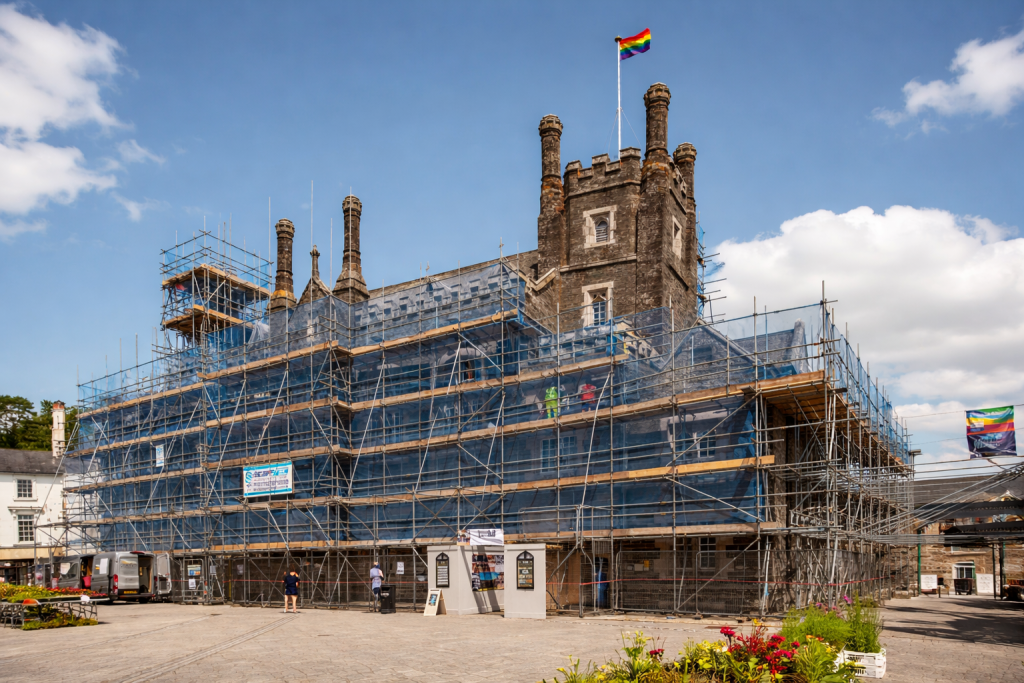
Our involvement in projects at Exeter Cathedral, Tavistock’s Town Hall, Guildhall and Butchers’ Hall reflects both the variety of our heritage work and the trust placed in us to undertake construction and restoration within historically significant environments.
Understanding the Building
No two historic buildings are quite the same. Construction methods, materials and subsequent alterations can vary considerably, even between properties of a similar age. Understanding these differences is fundamental to planning and carrying out work appropriately.
Traditional building materials often behave differently from their modern equivalents. Historic masonry, lime mortars, timber structures and older forms of construction require careful consideration, particularly where repairs or alterations must integrate with existing fabric.
Our approach begins with understanding the building itself, its condition, its construction and the purpose of the proposed work. Where appropriate, this involves working alongside conservation specialists and other professionals to establish suitable methods and materials before construction begins.
The aim is to achieve a sound, lasting result without unnecessarily disturbing the features that give a historic building its character.
Experience Across Some of Devon’s Most Important Buildings
We are fortunate to have worked on a number of buildings that hold considerable importance within their communities.
Exeter Cathedral is among Devon’s most recognisable historic landmarks, with an architectural history stretching back centuries. Working within an environment of such significance demands a particularly considered approach, with an appreciation of both the building and the responsibilities associated with its preservation.
Closer to home, our work on Tavistock’s Town Hall, Guildhall and Butchers’ Hall has provided opportunities to contribute to the care and continued use of buildings that form an important part of the town’s architectural heritage.
These are buildings with distinct histories and individual requirements. They are also places that remain closely connected to the community, making their ongoing maintenance, adaptation and preservation particularly important.
Our work at Butchers’ Hall received recognition through the Devon Historic Buildings Trust Awards, an acknowledgement of the standards achieved on a project involving one of Tavistock’s most distinctive historic buildings.
While the nature and scope of each commission differ, the underlying principles remain consistent: respect for the existing structure, appropriate construction methods and careful attention to detail throughout.
Working Together to Protect Our Built Heritage
Successful heritage projects depend on effective collaboration between everyone involved.
Architects, conservation officers, structural engineers, surveyors, planning authorities, building control professionals and specialist contractors each bring valuable expertise to the process. Establishing a clear understanding of the project’s objectives, constraints and responsibilities from the outset helps ensure that work progresses efficiently and that important conservation considerations are properly addressed.
We recognise the importance of maintaining open communication throughout a project, particularly when working with older structures where unforeseen conditions can emerge once work is underway.
Experience has taught us that a degree of flexibility is often necessary. Existing construction may differ from historical records or initial surveys, and previously concealed elements can require a reassessment of the proposed approach.
In these circumstances, practical experience, sound judgement and a willingness to work collaboratively are essential.
Balancing Conservation with Modern Requirements
One of the more complex aspects of heritage construction is accommodating contemporary expectations within buildings that were designed and constructed for a very different age.
Structural improvements, accessibility, building services, fire safety and changes in use can all introduce challenges, particularly where original architectural features must be retained.
Finding appropriate solutions requires a thorough understanding of the building, careful planning and close cooperation with the relevant professional teams and statutory authorities.
The objective is not simply to make an older building suitable for modern use. It is to do so in a way that respects its historic significance, avoids unnecessary intervention and supports its continued use for generations to come.
A Responsibility We Take Seriously
Historic buildings are an irreplaceable part of our built environment. They tell the stories of our towns, communities and the people who have lived and worked within them.
As a Tavistock-based contractor established in 1992, we have developed a strong connection with the architectural heritage of Devon. Being involved in the care and preservation of buildings such as Tavistock’s Guildhall, Town Hall and Butchers’ Hall is something we value greatly.
Our experience has reinforced the importance of approaching each project on its own merits, recognising that successful conservation work relies as much on understanding and cooperation as it does on construction skills.
Ultimately, our role is to help ensure that these buildings remain structurally sound, functional and respected, while retaining the character and craftsmanship that make them worth preserving.
It is a responsibility we take seriously, and one that continues to be an important part of our work.